


Customize SciSure to work your way
Your lab, your workflows, your way. SciSure gives you full control over how you connect your research tools, instruments, and databases. Create custom connections that fit exactly how your team works–now and in the future.
.avif)
Trusted by 550,000+ scientists, EHS, and LabOps worldwide in 55,000+ laboratories










 Customer story
“Working with the SciSure team has been a collaborative and productive experience.”
 Customer story
"SciSure helps us save time by enabling us to share our protocols with colleagues easily. It also takes care of our sample management."
 Customer story
“I'm thoroughly impressed with how SciSure has transformed our daily operations.”
 Customer story
“SciSure cuts down time and energy spent on tasks. I’ve loved working with it.”
 Customer story
“We’ve replaced Excel, paper, and Access databases with efficiency, turning manual tasks from hours into minutes.”
Customer story“Working with the SciSure team has been a collaborative and productive experience.”
Customer story"SciSure helps us save time by enabling us to share our protocols with colleagues easily. It also takes care of our sample management."
Customer story“I'm thoroughly impressed with how SciSure has transformed our daily operations.”
Customer story“SciSure cuts down time and energy spent on tasks. I’ve loved working with it.”
Customer story“We’ve replaced Excel, paper, and Access databases with efficiency, turning manual tasks from hours into minutes.”
Build a platform that works for you
Ready-to-use integrations
Instantly connect SciSure to 40+ prebuilt add-ons to streamline workflows without extra setup.
Related:

40+ integrations

Free and premium add-ons

Constantly growing library
.avif)
Custom integrations with our API & SDK
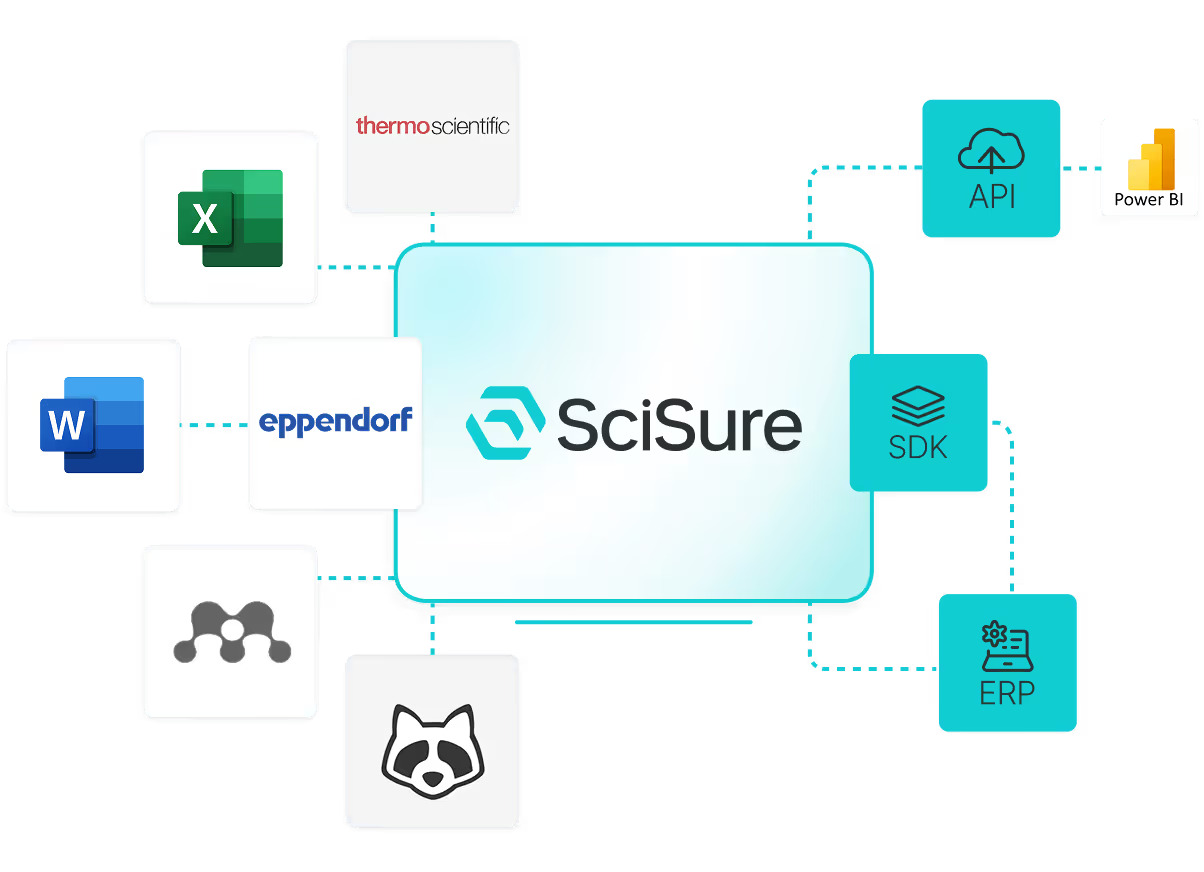
Build custom integrations with SciSure’s open API and SDK to connect lab instruments, automate reporting, and sync data.
Related:

Open API

Developer SDK

Full developer support
.avif)
Flexible & adaptable to your lab’s needs
Easily integrate new tools as your lab evolves without switching platforms or disrupting workflows.
Related:

Connect any research tool

Automate your workflows

Future-proof your setup
.avif)
Connect instantly with 40+ add-ons
Our Marketplace offers a range of integrations to streamline operations, data collection, and research workflows.

Astra Iris - AI Support Assistant
AI-powered support assistant built directly into SciSure Research.
DataChaperone - Analysis & AI Platform
Automated, audit-ready data analysis directly inside your ELN.
.png)
DYMO® LabelWriter™ 550 Series
Streamline your lab labeling workflow with precision and ease
.avif)
DMPTool.org
Streamline workflows and enhance collaboration by integrating and managing data management plans from DMPTool within SciSure
.avif)
Protocols.io
Bring trusted protocols directly into your ELN
.avif)
Nikon NIS-Elements
For seamless exchange of data and notes between Nikon NIS-Elements microscopy-based imaging platform and eLabNext
Empower your lab with custom integrations
SciSure’s API and SDK give labs complete flexibility to build integrations that fit their unique workflows.


.avif)
How labs are customizing SciSure to their needs
See how research teams are connecting their tools, automating workflows, and optimizing data flow with SciSure.













See SciSure in action
Every lab is different, and SciSure is built to adapt. Book a demo today to see how our Scientific Management Platform (SMP) can transform your team’s workflows, streamline compliance, and help your research move faster.
Frequently asked questions
Everything you need to know about the product and billing.
SciSure supports prebuilt add-ons from our Marketplace, direct API connections, and fully customizable integrations via our SDK.
No. Many integrations are plug-and-play. However, some integrations require a paid license.
Most add-ons are free, while some premium integrations require a subscription. Pricing details are available in the user interface Marketplace.
Yes! SciSure’s API allows you to connect lab instruments, automate data collection, and sync results with your workflows.
Visit our Developer Portal for API documentation, SDK downloads, and integration guides.
Can’t find the answer you’re looking for? Please chat to our friendly team.
Stay ahead in lab innovation
Electronic lab notebooks (ELNs) are easy to compare in a spreadsheet and much harder to adopt in a working lab. You can shortlist tools by feature coverage, pricing, reviews and ratings, or implementation estimates. But the real test is whether scientists, lab managers, IT, QA teams, and leadership can move daily work into the system without losing momentum.
This guide looks at ELNs and ELN-connected lab platforms through two practical lenses that work together: ease-of-use and time to return on investment (ROI). Public reviews matter, but ease-of-use also depends on:
- Whether the platform fits your lab's workflows,
- Whether implementation helps users build confidence,
- and whether the system creates value before the rollout turns into another long internal project.
Those same factors drive ROI, which is why we look at the two side by side rather than separately.
Of the five platforms compared here, SciSure has the shortest reported time to ROI (8 months), even though it sits in the middle on setup time (3 months). A faster implementation does not always mean a faster payback, and a slightly longer setup can sometimes get a lab to value sooner. We’ll cover why that happens below.
Who this ELN comparison guide is for
This guide is for research, biotech, pharma, academic, and enterprise lab teams comparing ELN platforms, where adoption risk is often the difference between a useful system and an expensive shelfware problem. Often, a low or failed adoption rate can also signal that an organization hasn’t achieved its initial objectives, leaving itself open to both data loss and compliance risks.
How quickly a tool earns back its cost depends heavily on whether people actually use it, so adoption and ROI are closely linked.
If your team is moving from paper notebooks, OneNote, spreadsheets, shared drives, or a legacy ELN, the purchase changes how people record experiments, find samples, use protocol templates, attach files, review records, sign completed work, and share data across teams.
Is time to implement the same as time to value?
No, and the public G2 data shows why it helps to ask both.
Time to implement is how long it takes to set the system up: configure it, migrate your data, train users, and go live. Time to value, often reported as time to ROI, is how long it takes for the system to pay back what you spent on it. A lab can finish implementation quickly and still wait many months before the system earns its cost back. Another lab can spend a few extra weeks on setup and reach payback sooner.
A shorter implementation is not automatically better or worse.
What matters is what you’re setting up in the first place. A turn-key tool with a two-month setup can keep delivering more value as adoption deepens over the following year, which often shows up as a longer reported ROI window. A platform that spends a little longer on configuration and training first can move users into real workflows sooner, which can shorten the payback period. Both figures are self-reported aggregates, so treat them as a public snapshot, not a guarantee for your specific lab.
For SciSure, the difference between a 3-month setup and an 8-month payback reflects where the work goes. Onboarding starts with an Implementation Readiness call in the first week, then a train-the-trainer model turns your own key users into the people who roll the system out and answer questions internally. A six-week adoption review checks that the rollout landed, and Value Realization Calls revisit adoption, outcomes, and ROI against shared metrics like user activation, workflow efficiency, and compliance improvements. The payback window is something the process is built to measure, not assume.
The practical takeaway for buyers: ask every vendor two separate questions.
- How long until we go live?
- And how long until this pays for itself?
Then ask what 'value' means at each checkpoint, so the answer is tied to something measurable rather than a feeling.
Why does an ELN with a strong implementation process matter?
A strong implementation process gives users a clear path from their current workflow to the new one. It also protects the investment, because a system people trust and use is a system that pays back. And in 2026, the expectations around research records keep rising. For example:
- The NIH Data Management and Sharing Policy asks National Institutes of Health (NIH) funded researchers and institutions to plan how scientific data will be managed and shared.
- The FAIR Principles push teams toward records that are findable, accessible, interoperable, and reusable.
- Food and Drug Administration (FDA) regulated teams must also account for trustworthy electronic records and signatures under 21 CFR Part 11, plus the FDA's October 2024 guidance on electronic systems, electronic records, and electronic signatures in clinical investigations.
- Clinical-trial teams should also watch the International Council for Harmonization (ICH) E6(R3) Good Clinical Practice guideline, finalized at Step 4 in January 2025.
In plain lab terms, these standards affect audit readiness, data integrity, reproducibility, electronic recordkeeping, funding expectations, and your ability to explain what happened later. A usable ELN helps your team capture that evidence as work happens, instead of reconstructing it before a grant report, quality review, inspection, tech transfer, or due diligence request.
How we evaluated these ELN tools
We evaluated these ELN and ELN-connected lab platforms using public G2 review data, public vendor documentation, customer-story evidence, and implementation signals that buyers can check for themselves.
- Public G2 review data.
Overall rating, total review count, G2 category presence, and the number of G2 review themes listed under "Ease of Use" in each product's Pros & Cons section where G2 displays that theme.
- Public implementation data.
G2's "Time to Implement" score where published and publicly available. If G2 does not publish a time-to-implement metric on the reviewed page, we do mention that upfront.
- Public product documentation.
ELN, Laboratory Information Management System (LIMS), inventory, application programming interface (API), compliance, and workflow capability claims from vendor pages or public G2 product descriptions. Our best-fit labels are based on what each platform appears strongest for, not a universal best-to-worst ranking.
- Public customer evidence with concrete outcomes.
While comparing solutions, do keep in mind that user reviews are subjective. A tool that feels intuitive to one team may feel too structured for another, too broad for a small group, or too limited for a multi-site program. G2 counts also change over time, and review themes are generated from available reviews, so treat the data as a public snapshot, not a permanent score.
Here’s also how we selected the core comparison set: products with public G2 review pages that show clear ELN or LIMS relevance and public "Ease of Use" review-theme counts. G2 also publishes time-to-implement metrics for SciSure, SciNote, and Labguru. IDBS E-WorkBook and Benchling are included as shortlist benchmarks because many ELN buyers compare them, but their G2 time-to-implement metrics were not published on the pages reviewed.
SciSure is one of the platforms featured in the table. We based inclusion on publicly available data and real user reviews, so you can decide what fits your lab.
The best ELN for Labs in 2026 ranked by ease of use and time to ROI
The table below uses publicly available G2 data based on the number of reviews for the “Ease of Use” criterion, as well as G2’s “Return on Investment” figure in each platform’s Pricing section, wherever available. One difference is worth noting before you read it: of the five platforms here, SciSure is also the only one that also offers environment, health, and safety (EHS) capabilities, which matters for R&D teams that have to stay audit-ready.
The right ELN depends on your lab type, implementation needs, and workflow complexity. Here are 5 of them based on where they work best and why a solid Implementation process should be the backbone of your procurement efforts.
SciSure ELN: Best for enterprise R&D teams that need guided implementation and configurable ELN workflows
SciSure is best for labs that want superior (head of lab) and a researcher to come from fit: configurable workflows, ELN and inventory context, application programming interface (API) and software development kit (SDK) extensibility, and a hands-on implementation process that helps teams reach value in weeks. On G2, SciSure has an overall 4.2/5 rating across 194 reviews, with 43 "Ease of Use" mentions in the Pros & Cons section. G2 lists a 3-month average time to implement and ROI within 8 months, the shortest payback window of the five platforms here.
SciSure's ELN helps you organize research records around projects, studies, experiments, samples, protocols, attachments, permissions, signatures, and integrations. That matters for enterprise teams because daily lab work rarely follows one vendor-defined template. One group may need assay templates and protocol versioning. Another may need sample traceability, barcoding, inventory links, and instrument or database integrations. IT may need single sign-on (SSO) and role-based access, while QA may need audit trails, signatures, and controlled records.
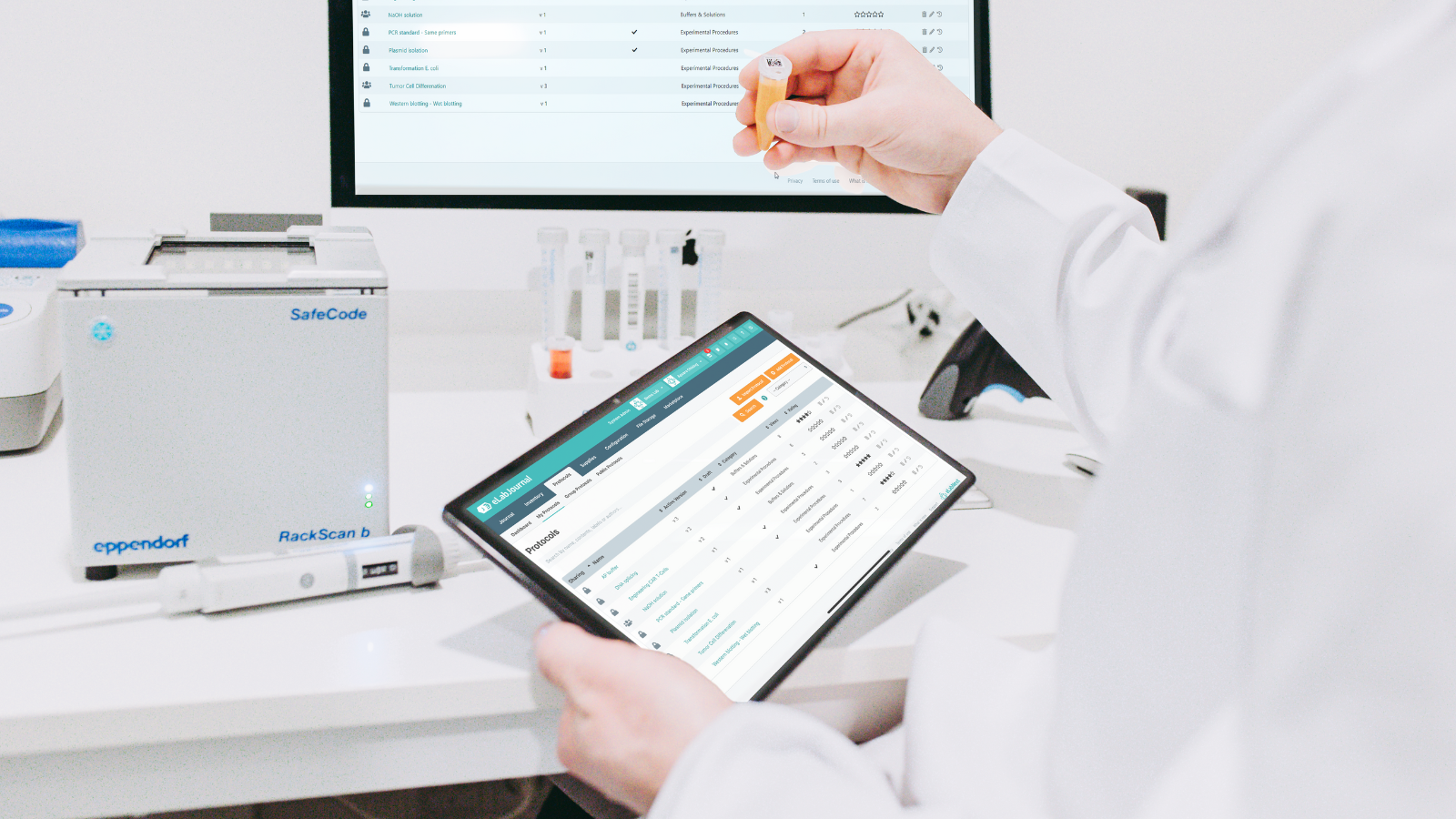
The key ease-of-use point is configurability.
SciSure ELN's strength is that you can adapt workflows, templates, sample structures, and integrations around how your team works. That fit is also what shortens the path to ROI: when the system matches real workflows, people adopt it faster, and adoption is what turns a purchase into value. A rigid ELN can feel easy during a demo and become difficult once your lab needs a workflow the vendor did not design for.
The implementation process is part of the ease-of-use claim.
With SciSure, onboarding starts with an Implementation Readiness call within about a week of signing, then moves into workflow alignment, configuration, training, and adoption support. For on-prem and private cloud deployments, that process becomes a tailored implementation trajectory created with our client teams. This plan accounts for the way your organization actually works: local language needs, regional culture, internal preferences, site-level processes, user groups, and the pace at which the team wants to roll out change.
That international and multilingual support matters because ease of use is at least partly cultural. A research workflow that feels natural in one country, department, or operating model may need different terminology, training, and rollout sequencing somewhere else. For EU implementations in particular, local language and local ways of working can shape whether scientists feel supported from the start. A successful rollout gives users enough context to complete real lab tasks, find records, understand permissions, link samples, reuse templates, and know where to go when questions come up.
Software doesn’t run itself
The whole point of our detailed implementation process is simple: before rollout, you do need to secure buy-in from its users. This means making it as easy as possible for them to make usage a habit. For a turn-key platform, a thoughtful implementation often beats a rushed one. The value comes from helping scientists and managers trust the new workflow. The goal is for users to complete real lab tasks, find records, understand permissions, link samples, reuse templates, and know where to go when questions come up.
Here’s an example: Boston University selected SciSure’s ELN and LIMS and its associated API to support an internal COVID-19 testing lab. SciSure's APIs helped integrate testing robots with the ELN, and the lab was running two months after implementation. At its peak, it processed more than 9,000 samples per day.
SciSure's broader platform scope means your team should define the first rollout lane clearly. Decide whether the first value milestone is ELN documentation, protocol standardization, sample traceability, inventory linkage, review and signature workflows, or integrations. SciSure can support a wider enterprise path, but adoption starts with one concrete workflow.
SciSure’s Environmental, Health, and Safety (EHS) features
There is also one capability in SciSure's range that none of the other tools here offer: environment, health, and safety (EHS). Most labs run their science in one system and their safety and compliance in another. SciSure comes from a company that does both, so the vendor behind your notebook can also support chemical inventory safety, training compliance, and the documentation an inspector asks for. If you’ve ever scrambled to assemble safety records before an audit, that matters.
SciNote: Best for straightforward ELN documentation and task-based lab work
SciNote is best for teams that want a structured, approachable ELN for experiment documentation, protocols, inventory, and day-to-day lab coordination, without a broader enterprise platform strategy.
On G2, SciNote has a 4.2/5 rating across 303 reviews, and 35 "Ease of Use" mentions in the Pros & Cons section at the time reviewed. G2 lists a 2-month average time to implement and ROI within 18 months. SciNote's public product description emphasizes ELN, LIMS, laboratory data management, inventory and sample tracking, standard operating procedure (SOP) and protocol management, roles and permissions, audit trails, and API availability.
SciNote can be a good fit when the immediate goal is to replace scattered notebooks, files, and informal task tracking with a clearer digital system. If your team mainly needs structured documentation, protocol organization, project visibility, and sample or inventory context, SciNote's workflow model can help lower the first adoption barrier.
One thing to test during a pilot: structure can feel helpful or restrictive depending on the team. If your scientists expect very flexible notetaking, or if your organization needs enterprise governance across many labs, sites, integrations, and stakeholders, run real experiment templates, sample links, search, permissions, and review steps before deciding. Those same tests tell you how quickly people will adopt the system, which is what drives the return.
Labguru ELN/LIMS: Best for growing teams that want an approachable structure
Labguru is best for smaller biotech teams that want to bring experiment documentation, project visibility, inventory, and sample tracking into a more organized daily workflow.
On G2, Labguru ELN LIMS has a 4.6/5 rating across 165 reviews, with 18 "Ease of Use" mentions in the Pros & Cons section. G2 lists a 2-month average time to implement and ROI within 13 months. The G2 product description frames Labguru as a cloud-based ELN, LIMS, and informatics platform for life science research and industry, with support for experiments, workflows, project management, collaboration, and inventory.
Labguru can be a good fit when a team has outgrown spreadsheets and needs one connected place for experiments, materials, projects, and samples. That is especially relevant when a few people are handling documentation, inventory, ordering, sample tracking, and project coordination at once.
One thing to confirm during evaluation: as your workflows grow more specialized, check how much your team can configure directly, the extent of paid vendor intervention you can rely on, and how the platform scales across new groups, sites, compliance needs, and integrations. Those answers shape both day-to-day ease of use and how long the system takes to pay back.
IDBS E-WorkBook: Best for teams that need structured, template-driven capabilities
IDBS E-WorkBook is best for teams that need secure data capture, structured collaboration, configurable templates, and laboratory execution system (LES) or LIMS-adjacent workflows alongside ELN functionality.
On G2, IDBS E-WorkBook has a 4.4/5 rating across 25 reviews, with 6 "Ease of Use" mentions in the Pros & Cons section at the time reviewed. G2 did not publish a time-to-implement metric on the page we reviewed, nor any ROI figures. Its public product description positions E-WorkBook as an ELN, LES, and LIMS platform for research, development, and manufacturing, with configurable templates, secure data capture, workflow collaboration, and regulatory compliance support.
IDBS can be a strong fit when a lab needs more structure than a simple notebook and wants ELN records to sit closer to laboratory execution, process development, or regulated data capture. That makes it relevant for teams that need standardized methods, controlled templates, and documented collaboration across research and manufacturing-adjacent work.
Because there is no public G2 time-to-implement or ROI figure here, ask the vendor directly: how much can your team configure, what services are required, how does the platform support your first rollout group, and how quickly can users complete a real workflow. Those answers are how you estimate both ease of use and time to value when the public data is thin.
Benchling: Best for sequence-heavy, molecular biology research
Benchling is best for teams doing sequence-heavy, molecular biology research that want notebook, registry, molecular biology tools, inventory, requests, workflows, and insights in one R&D cloud.
On G2, Benchling has a 4.5/5 rating across 65 reviews and appears in both the LIMS and ELN categories. The Pros & Cons section surfaced 1 "Ease of Use" theme count on the page we reviewed, while the page's AI-generated review summary reports that users consistently praise ease of use and feature breadth. G2 did not publish a time-to-implement metric or ROI figures on the page we reviewed, so make sure you confirm implementation timeline, services scope, migration effort, and time to value directly during evaluation.
Benchling can be a strong fit when research is sequence-heavy, and your team needs connected molecular biology, registry, notebook, inventory, and workflow functionality. If your scientists work with constructs, plasmids, cell lines, and assays, the broader R&D cloud can be more relevant than a standalone ELN.
One thing to weigh: broad platforms can introduce more implementation and governance work, which affects both how easy the system is to adopt and how soon it pays back. During evaluation, ask how much your internal team can configure, what support is included, how data migration will work, and when the first group can use the system for real.
How to choose an ELN based on ease of use and concrete ROI figures
For enterprise teams, the most useful buying signal is a vendor that can align to your timeline, start the readiness process quickly, configure around your actual workflows, train users in context, and show measurable value before the full roadmap is complete. Implementation speed is one input, and rarely the deciding one.
Use this checklist to compare ELN vendors on adoption, workflow fit, implementation quality, and feature coverage.
Usability
Can your scientists complete a real experiment workflow in the system during the evaluation, including protocol selection, data entry, attachments, sample links, review, and search?
Configuration
Can you configure templates, fields, permissions, and workflows around your lab's terminology without waiting for vendor-side custom development? Likewise, can the platform support your next phase without forcing a rebuild, such as adding new assay types, new sites, integrations, automated sample workflows, or regulated review steps?
A proper plan
Can the vendor show how implementation starts, who is involved, and what happens in the first week after signing?
Time to implement vs time to value
Can the vendor separate implementation duration from time to value, with a first measurable workflow milestone in weeks?
Findability
Can your team link ELN records to samples, inventory, protocols, files, equipment, or instruments where those links matter? Can IT and QA see how SSO, user roles, audit trails, signatures, retention, and validation support will work in your environment?
Connectivity
Can one vendor cover the capabilities you need now and next, including ELN, inventory, and the safety and compliance side, so you’re not stitching together separate tools? Likewise, can the platform handle both turn-key workflows and future complexity through APIs, SDKs, marketplace add-ons, or integrations?
Training
Can the vendor explain what training looks like for scientists, lab managers, admins, IT, and compliance users?
Impact
Can the vendor help you define adoption metrics, such as time to find a sample, number of active users, template reuse, signed records, or reduced manual tracking?
FAQs
What is the easiest ELN to use in 2026?
The easiest ELN to use is the one your team can adopt for real workflows, not the one with the simplest demo screen. Public G2 data can help you compare user sentiment. In this snapshot, here’s what turn up from the reviewed G2 pages at the time of publishing this article:
- SciSure has 43 "Ease of Use" mentions with 3 months to implement, 8 months to ROI
- SciNote has 35 "Ease of Use" mentions with 2 months to implement, 13 months to ROI
- Labguru has 18 “Ease of Use” mentions with 2 months to implement, 18 months to ROI
- IDBS E-WorkBook has 6 “Ease of Use” mentions with both undisclosed times to implement and ROI.
- Benchling had 1 “Ease of Use” mention, with both undisclosed times to implement and ROI.
Those counts are a useful signal, not a verdict. The tool that is easiest to adopt also tends to reach payback sooner, because adoption is what converts a purchase into value. Test the tasks your scientists do every week: create an experiment, reuse a protocol, attach files, find a sample, search an old record, review work, and sign when required.
Is a shorter ELN implementation period always better?
No, not necessarily. A shorter ELN implementation period helps only if users reach value quickly, and the rollout does not skip the work that adoption needs.
For turn-key platforms, training, readiness calls, workflow alignment, and phased onboarding can make the first months more useful. For heavily customized platforms, a longer timeline may reflect data modeling, migration, integration, validation, and vendor-side build work.
Make sure to ask every vendor:
- What action steps users can take after 2 weeks, 30 days, 60 days, and 90 days
- When the system is expected to pay back
How should regulated labs evaluate ELN ease of use?
Regulated labs should evaluate ease of use by checking whether the system makes controlled work easier to perform correctly.
Users should be able to follow approved templates, use current protocol versions, link samples and files, preserve audit trails, apply permissions, review completed records, and sign or witness records where required. In FDA-regulated environments, electronic records and signatures must be considered in the context of Part 11, validation, SOPs, training, and intended use. Getting this right is also a cost question, since controlled work that is easy to do correctly avoids expensive findings later.
What should academic labs prioritize in an ELN?
Academic labs should prioritize searchability, training speed, low-friction documentation, protocol reuse, sample context, collaboration, and data stewardship. Enterprise academic environments should also weigh implementation support, permissions, integrations, governance, and cross-lab scalability.
Grants, publications, student turnover, shared instruments, and multi-lab collaborations all depend on records that future users can understand. NIH data-sharing expectations and FAIR data principles make early record structure more important, even when a lab is not regulated.
For large research universities, ease of use also depends on whether the ELN can support many groups without turning onboarding, permissions, integrations, or support into a separate project for every lab, which is also what keeps the cost of ownership reasonable.
Watch out: some platforms do scale back functionality for academic institutions. So, make sure you’re extra thorough during your vendor calls, when it comes to getting all the features your lab needs. Website information might often provide a commercial-only solution. Or, some platforms may place data ownership with the individual user, not the institution, which might leave you open to significant IP risk.
What should enterprise R&D teams prioritize in an ELN?
Enterprise R&D teams should prioritize configurability, implementation support, permissions, integrations, data model flexibility, API and SDK extensibility, and adoption metrics.
At enterprise scale, ease of use depends on whether the platform can support different groups without fragmenting into workarounds. A system should be easy for scientists at the bench, manageable for admins, credible for IT and QA, and adaptable when research priorities change. Those same qualities protect the return, because fragmentation and workarounds are where value leaks away.
What should small to mid-size startups prioritize in an ELN?
Small to mid-size startups should prioritize day-one usability and long-term scalability at the same time.
If you’re leading an early-stage team, it’s tempting to want to choose the tool that feels easiest to start with. The risk is choosing a system that fits the first five users but struggles once the company grows. Meaning, if you add more programs, or more sample types, more instruments, more collaborators, more regulatory expectations, or more sites. Simpler, task-first ELNs may work well for an early documentation need, but startups should ask how quickly they might outgrow that structure.
Always keep in mind that migration is the hidden cost. Moving existing experiments, samples, protocols, attachments, metadata, signatures, and user habits into a new platform later can be more expensive and riskier than you might expect. You’ll also need to retrain users, rebuild templates, revalidate workflows where required, and regain trust from scientists who already changed systems once.
For startups, the practical question is: can this ELN support the company you expect to become? Look for a platform that can start with a focused workflow, then grow into sample traceability, inventory links, permissions, integrations, automation, compliance controls, and multi-team governance without forcing a platform switch.
How does SciSure support easily implementable ELN workflows?
With SciSure, you start with a guided implementation process, configure workflows around your lab's actual work, and extend the platform through integrations, API, and SDK-supported automation where needed. For On-Prem and Private Cloud deployments, SciSure can support a more tailored implementation trajectory created with the client team. That can include workflow alignment, configuration, training, adoption support, local language considerations, regional working styles, site-level processes, and rollout pacing for international or multilingual teams.
That combination gives teams a practical path from an initial turn-key workflow to enterprise-scale use. Boston University used SciSure for Research and API integrations to support an internal COVID-19 testing lab that was up and running two months after implementation. Food Brewer likewise used SciSure and the SDK to support traceable cultivated cocoa R&D and reported 60% productivity gains in R&D and 40% in upstream processing.
If ease of use is a buying criterion for your ELN, evaluate the full adoption path
That means looking at what users do first, how workflows are configured, how implementation begins, how quickly your team sees value, and how the system adapts as your lab grows. Ease of use and ROI are the same question asked in two ways: a tool people adopt is a tool that pays back.
See how SciSure supports easily implementable ELN workflows for enterprise R&D, biotech, pharma, academic, and lab operations teams that need an ELN rollout they can actually trust.
Sources
G2 review data checked as of July 16, 2026, on the public review pages for SciSure, Labguru ELN LIMS, SciNote, IDBS E-WorkBook, and Benchling. G2 counts and themes change over time, so treat them as a public snapshot.
IDBS E-WorkBook and Benchling are included because enterprise ELN buyers commonly compare them, but G2 did not publish time-to-implement metrics on the pages reviewed. Keep that caveat unless public implementation metrics are added later.
Food Brewer and Boston University figures are from SciSure's public customer stories.
Relevant regulatory and research standards:
- NIH Data Management and Sharing Policy: https://grants.nih.gov/policy-and-compliance/policy-topics/sharing-policies/dms
- FAIR Principles: https://www.go-fair.org/fair-principles/
- 21 CFR Part 11 (Electronic Records; Electronic Signatures): https://www.ecfr.gov/current/title-21/chapter-I/subchapter-A/part-11
- FDA, Electronic Systems, Electronic Records, and Electronic Signatures in Clinical Investigations (October 2024): https://www.fda.gov/regulatory-information/search-fda-guidance-documents/electronic-systems-electronic-records-and-electronic-signatures-clinical-investigations-questions
- ICH E6(R3) Good Clinical Practice, Step 4 final guideline (January 2025): https://database.ich.org/sites/default/files/ICH_E6(R3)_Step4_FinalGuideline_2025_0106.pdf

The 5 Best Electronic Lab Notebooks (ELN) in 2026 Ranked by Ease-of-Use & ROI: Based on Real User Reviews
5 ELN systems ranked on how they support lab workflows for enterprise R&D, biotech, pharma, academic, and lab operations teams.
Congratulations, you have an electronic lab notebook! Now you need the daily habits, templates, sample links, review steps, and data controls that make the system useful after go-live.
That next phase matters because an ELN only helps when your scientists use it to capture the full research story: what they did, which protocol version they followed, which sample or reagent lot they used, which file supports the result, who reviewed the work, and how someone can find the record later.
In this post, we'll cover some electronic lab notebook (ELN) best practices, so you can get your lab up and running in no time.
What should you do first after implementing an ELN?
After implementing an ELN, you should turn your first live workflows into repeatable lab standards before your team creates hundreds of inconsistent records.
Start with one active workflow that matters this month. Choose a workflow where better documentation will help immediately, such as a weekly qPCR assay, a cell passage record, a protein purification run, a stability study, a chemical inventory update, or a sample intake process.
For that workflow, decide:
- Where the experiment should live.
- Which project or study owns it.
- Which sample, reagent, consumable, or equipment fields matter.
- Which protocol version scientists should use.
- Which files users should attach, such as plate reader exports, images, spreadsheets, scripts, or instrument reports.
- Which metadata someone will need for search later.
- Who can create, edit, review, sign, witness, archive, export, or restore the record.
This first pass should feel concrete. A scientist should know how to open the right template, link the correct sample, add the result file, write the interpretation, and send the record for review without asking where everything goes.
Next, avoid turning the first month into a platform tour. Your team needs usable lab workflows, not a catalog of features. If people can complete one real task cleanly, you can extend the same pattern to the next workflow.
How should you structure projects, studies, and experiment records?
You should structure your ELN around the way your lab organizes real work: group, project, study, experiment, protocol, sample, storage location, and reviewer.
A clear structure helps scientists find records later. It also helps lab managers, PIs, QA teams, and collaborators understand which work belongs to which program, grant, product candidate, assay family, or study.
For example, a protein engineering team might structure a project by target, study by variant library, and experiment by expression run or assay plate. A cell therapy team might structure a project by program, study by donor or process stage, and experiment by sample preparation, QC test, or batch-related observation.
The structure should help someone answer one question quickly: can I find the record, understand the sample and protocol context, and repeat or review the work later?
How do templates and protocols fit into electronic lab notebook best practices?
Templates and protocols improve electronic lab notebook best practices by giving scientists a consistent starting point for recurring work.
Templates save time because they remove blank-page decisions. A good template tells the scientist which sections, fields, samples, protocol links, attachments, calculations, and review steps the workflow needs.
Make sure to build templates for workflows your lab repeats often. For example:
- Cell culture passages with cell line, passage number, media lot, split ratio, contamination check, and freezer link.
- qPCR runs with sample IDs, primer lot, plate map, instrument file, control criteria, and result interpretation.
- Protein purification runs with construct ID, buffer lots, column ID, fraction map, gel image, yield, and storage location.
- Chemical inventory intake with container barcode, owner, location, hazard information, SDS link, quantity, and disposal date.
- Stability or formulation studies with batch ID, pull point, storage condition, test method, reviewer, and deviation notes.
Treat protocols as controlled research assets. Your team should know which protocol version applies, who can edit it, when review happens, and how users handle a protocol change during active work.
In daily lab work, the useful question is whether the ELN helps scientists create a complete record without fighting the format. With SciSure, you can build experiment templates that mirror real protocols, add checklists for routine steps, keep Word and Excel content readable when scientists bring in tables or notes, use formulas where calculations belong in the record, and link samples or files as part of the same workflow. That helps someone document a qPCR run, passage cells, record a purification, or prepare a stability pull without rebuilding the structure each time.
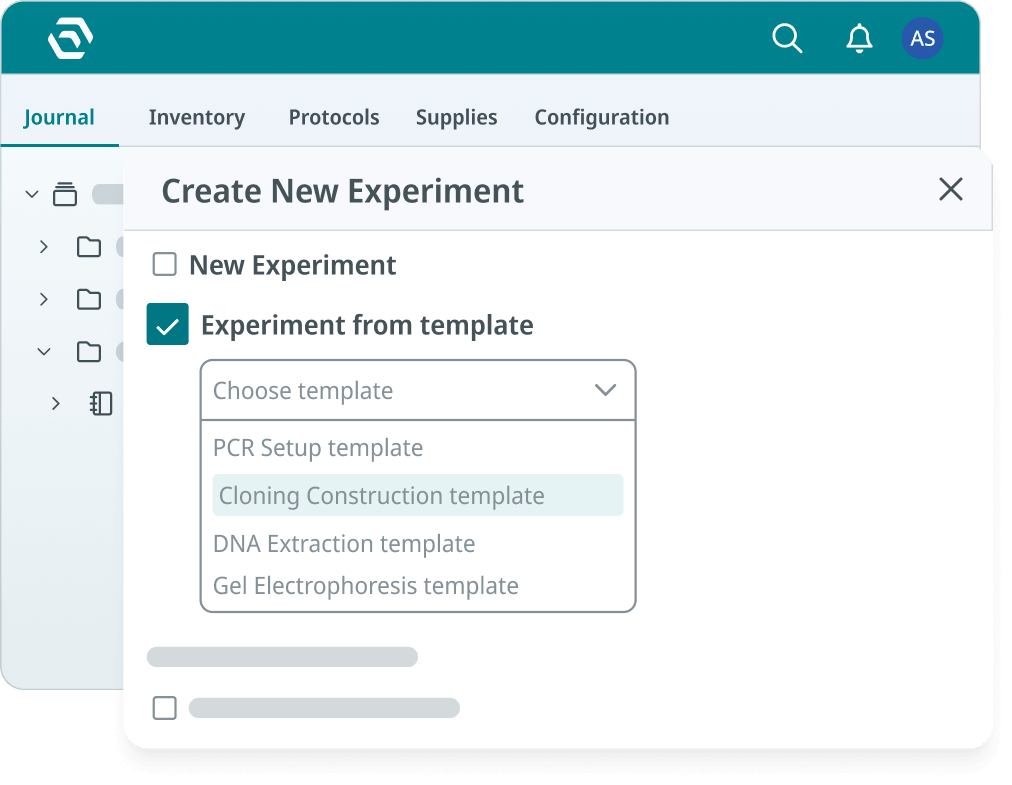
For lab leads and admins, the same details make governance easier. Reusable templates and default formatting keep records consistent across users, while advanced filters help people find the right template, prior experiment, or sample context faster. Roles and permissions help your team control who can edit methods, update samples, approve records, or manage shared structures. The practical value shows up as fewer cleanup passes, fewer side documents, and records another scientist can understand later.
How do you connect your ELN to samples, inventory, and lab safety?
You connect your ELN to samples, inventory, and lab safety by linking experiment records to the materials, storage locations, hazards, and operational workflows that scientists use every day.
This step often creates the biggest practical win. Many teams start with an ELN for notes, then discover that their real bottleneck sits in sample lookup, freezer maps, chemical inventory, reagent lots, SDS access, or equipment context.
Use these questions:
- Can a scientist link the sample they used directly inside the experiment?
- Can the lab manager find the sample by barcode, owner, storage location, sample type, or custom metadata?
- Can a reviewer see which reagent lot, chemical container, instrument, or file supports the result?
- Can EHS or lab operations connect chemical inventory, SDS access, regulatory reporting, inspection needs, or safety training to the same lab management strategy?
- Can a new team member find the right sample and protocol without asking the person who created the old spreadsheet?
If your lab runs sample-heavy research, connect ELN and LIMS workflows early. The SciSure ELN supports experiment documentation, collaboration, templates, approvals, version control, audit-ready records, and links to samples and inventory. Likewise, SciSure LIMS supports sample management, inventory, equipment, workflow automation, barcode label printing, user roles, access control, sample lifecycle tracking, and audit logs.
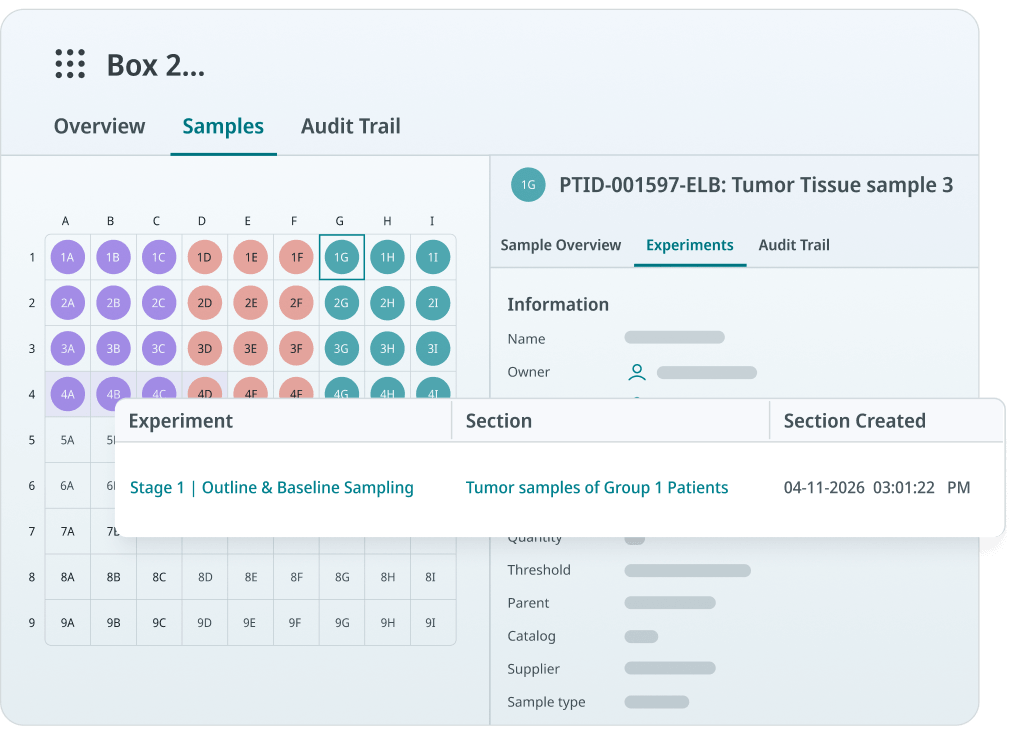
SciSure also includes Health & Safety workflows for regulatory adherence, risk management, audit readiness, chemical inventory and SDS, and regulatory reporting. That matters for life science research teams that manage experiments, samples, and laboratory safety together rather than in separate systems.
What should your ELN backup solution protect?
Your ELN backup solution should protect complete, retrievable research context, not just a file export.
An ELN backup matters because a lab record loses value when it loses the links that explain it. A useful ELN backup plan should help your team recover experiments, attachments, samples, storage context, protocol versions, signatures, audit trails, permissions, and archive indexes after deletion, system failure, migration, security incident, or vendor transition.
Ask your IT, platform, or vendor team these ELN backup questions:
- How often do backups run?
- Which data objects does the backup include?
- How long does the organization retain backups?
- Who can request a restore?
- How does the team test restore procedures?
- How do backups preserve attachments, sample links, signatures, audit trails, and permissions?
- How does the process support read-only archives for completed studies or old notebooks?
- How does the plan align with cybersecurity, business continuity, and disaster recovery expectations?
For security planning, the NIST Cybersecurity Framework 2.0 gives IT and risk teams a useful structure for identifying, protecting, detecting, responding to, and recovering from cybersecurity risk. In lab terms, that means your ELN backup solution should support recovery from ordinary mistakes, hardware problems, account issues, and security events without losing scientific context.
If your lab works under GxP, GLP, GMP, or Part 11 expectations, backup and restore testing also matters for audit readiness. A record that your team cannot retrieve during a quality review, inspection, grant report, or IP review will not help, even if the record once existed.
How do you secure ELN records for audit readiness and compliance?
You secure ELN records by controlling access, preserving change history, using signatures where your workflow needs them, and aligning each record type with the standards that govern your lab.
Compliance starts with scope. A discovery lab, core facility, nonclinical safety lab, clinical research team, QC lab, and GMP manufacturing support team all need different controls.
Use these current standards as a practical checklist:
- The NIH Data Management and Sharing Policy matters for funded research because your team needs a plan for managing and sharing scientific data.
- The FAIR Principles matter because searchable metadata, persistent identifiers, sample links, and clear access rules help other scientists find, access, reuse, and understand data.
- 21 CFR Part 11 matters when FDA-regulated electronic records or electronic signatures replace paper records or handwritten signatures.
- FDA's 2024 guidance on electronic systems, electronic records, and electronic signatures in clinical investigations matters for clinical investigation teams that need trustworthy electronic systems and records.
- 21 CFR Part 58 matters for GLP nonclinical laboratory studies because teams need to protect raw data, protocols, corrections, equipment records, specimens, archives, and study records.
- FDA's Data Integrity and Compliance With Drug CGMP guidance matters for GMP and QC teams because FDA expects reliable and accurate data.
- EudraLex Volume 4 matters for EU GMP teams, including Annex 11 for computerized systems and Annex 15 for qualification and validation.
- ICH E6(R3) matters for clinical research teams because it reinforces fit-for-purpose systems, proportionate quality management, and reliable trial records.
Next, translate those standards into daily controls:
- Require individual accounts instead of shared logins.
- Use role-based access for projects, experiments, samples, protocols, and administrative functions.
- Limit who can delete, archive, restore, export, sign, or witness records.
- Use audit trails that show who changed a record, when they changed it, and what they changed.
- Define when a record needs review, signature, witness approval, or locked status.
- Train users on correction rules, record ownership, naming conventions, file attachments, and retention.
- Review permissions when people join, change roles, or leave.
The point is simple: your ELN should help your lab prove what happened without rebuilding the story from emails, shared drives, paper notes, and memory.
How does an ELN save time after rollout?
An ELN saves time when your scientists can create records from templates, link samples directly, find prior work through search, reduce duplicate documentation, and review completed work without chasing files.
The answer to "how does an ELN save time" should come from specific lab tasks. For example:
- A scientist starts a new experiment from a validated template instead of copying an old Word file.
- A lab manager finds a sample by barcode, storage location, owner, or sample type instead of checking a freezer map spreadsheet.
- A reviewer opens one record with the protocol, sample, attachment, interpretation, signature, and audit history instead of asking for separate files.
- A new hire follows a standard protocol and template instead of learning an informal process from whoever has time.
- A PI searches by sample ID, project, assay, author, keyword, or date instead of asking multiple people for context.
And here's an example of how this looks in practice: Kaigene, a growth-stage biotech team based in Rockville, Maryland. With the SciSure platform up and running, the team moved away from Microsoft Office tools plus physical notebooks. Researchers had previously spent several hours or even an entire day on dual documentation, and SciSure helped them reduce data recording time, retrieve prior data more easily, and manage inventory more efficiently.

“SciSure has significantly reduced my workload and time required to record experimental results and data. Additionally, it enables me to retrieve other researchers’ data and manage inventory more efficiently. This improvement in research efficiency is crucial for startup biotechs like Kaigene, allowing us to focus more on innovation and increase overall productivity.”
- Junho Cho, Principal Scientist at Kaigene
How should you compare the main providers of ELN (electronic lab notebook) solutions?
You should compare the main providers of ELN (electronic lab notebook) solutions by testing how each platform handles your actual workflows, not by counting generic features.
If your search starts with "ELN for R&D technology providers," write down the work your team needs to control before you evaluate vendors. R&D teams often need experiment documentation, sample traceability, inventory, instrument files, protocol versions, collaboration, signatures, audit trails, migration support, integrations, security controls, and backup expectations.
Ask each provider:
- Can scientists create experiments from templates that match our assays, sample intake, synthesis, formulation, cell culture, QC, or core facility workflows?
- Can users link samples, inventory, storage locations, barcodes, and equipment directly to experiments?
- Can reviewers see protocol versions, attachments, comments, signatures, and audit history in one place?
- Can admins configure roles, permissions, SSO, exports, archives, and retention rules?
- Can the platform support ELN, LIMS, EHS, and integrations when the lab needs connected operations?
- Can the provider explain migration from paper, spreadsheets, shared drives, or another ELN?
- Can the provider support adoption with implementation planning, training, key users, and success metrics?
- Can your IT team test backup, restore, security, validation, and update procedures?
For R&D teams, the strongest ELN choice usually makes daily work easier while preserving context for the future. A shiny notebook interface won't help if your scientists still track samples in spreadsheets, save instrument files elsewhere, and ask one person where old records live.
How SciSure can support you in setting up your lab for success
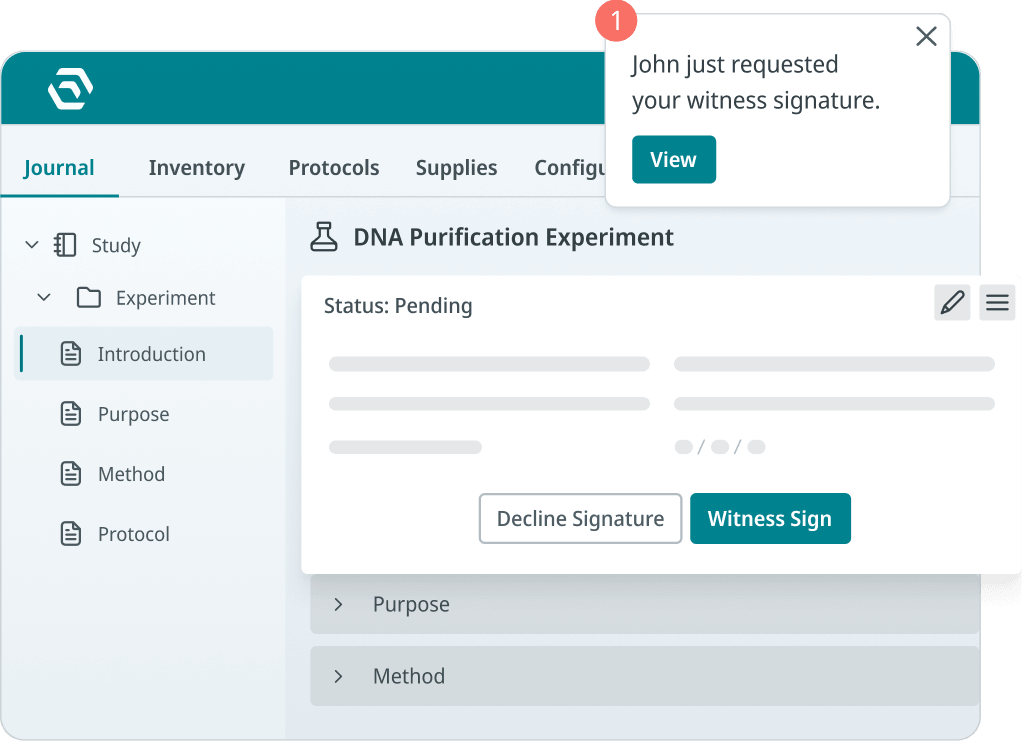
With SciSure, you can document experiments, collaborate in real time, create experiment templates, use advanced search, connect experiments to samples and inventory, attach images and files, request approvals, use witness signing, manage version control, and support GxP and FDA 21 CFR Part 11 workflows through the SciSure ELN.
With SciSure LIMS, you can manage samples, inventory, equipment, storage units, workflow automation, barcode labels, user roles, access control, sample lifecycle tracking, disposal tracking, and audit logs.
With SciSure EHS workflows, your team can connect lab safety needs such as chemical inventory and SDS, regulatory reporting, risk management, and audit readiness to the same broader lab management strategy.
With SciSure integrations, your team can extend workflows through add-ons, APIs, developer tools, and marketplace capabilities when your lab needs instrument connections, file workflows, reporting, automation, or specialized sample handling.
Finally, with SciSure's Implementation and Customer Success team, your team can get support for onboarding, project planning, milestones, key users, training schedules, technical implementation, data migration, and role-based training.
Use these capabilities to make the best-practice list operational:
- Turn recurring work into templates.
- Link each experiment to the relevant sample, inventory item, protocol, and attachment.
- Define permissions before broad rollout.
- Decide where signatures and witness review matter.
- Track sample history and audit logs.
- Plan migration and archive needs before changing systems.
- Train users through the tasks they perform every week.
FAQs: Electronic lab notebook best practices
Here are some questions we often run into during our onboarding and implementation rounds: Labs usually ask how to structure records, connect samples, protect backups, save time, compare providers, and decide whether SciSure can support electronic lab notebook and lab management workflows.
What are the best practices for ELN?
The best practices for ELN include project and study structure, reusable experiment templates, controlled protocols, sample and inventory links, metadata standards, access controls, audit trails, backup testing, training, and adoption metrics.
What should you include in an ELN backup plan?
An ELN backup plan should cover experiments, attachments, samples, inventory records, protocol versions, signatures, audit trails, permissions, exports, archive indexes, restore testing, retention rules, and recovery ownership.
How does an ELN save time?
An ELN saves time by reducing duplicate documentation, giving scientists templates, linking samples and files directly to experiments, improving search, simplifying review, and helping new team members follow standard workflows faster.
Does SciSure provide electronic lab notebook and lab management software for life science research teams managing experiments, samples, and laboratory safety?
Yes. A life science team can use SciSure to bring experiment documentation, sample traceability, inventory, and safety workflows into one connected lab management approach. In practice, that means scientists can document experiments in the ELN, build templates for recurring work, link records to samples or inventory, attach supporting files, and route completed work for review or approval.
- Lab managers and operations teams can use SciSure LIMS workflows to manage samples, storage locations, barcodes, equipment, inventory status, sample history, and audit logs.
- Safety and compliance teams can use SciSure EHS workflows for chemical inventory and SDS access, regulatory reporting, risk management, and audit readiness.
- Our Customer Success and Implementation teams can help your lab plan implementation, migration, training, and adoption so the platform fits the way the lab actually works.
When should a lab connect ELN and LIMS workflows?
Connect ELN and LIMS workflows early when experiments depend on samples, inventory, storage locations, equipment, barcodes, chain of custody, batch updates, or sample history.
How often should you review ELN templates and protocols?
Review ELN templates and protocols after the pilot, after the first 30 to 90 days, and whenever your lab changes a method, sample type, regulatory scope, instrument workflow, or review requirement.
What should you ask vendors about ELN backup and data migration?
Ask how each vendor handles backup frequency, restore testing, data exports, archive retrieval, paper notebook migration, legacy ELN migration, sample links, attachments, audit trails, signatures, permissions, and former user records.
If your ELN already exists but scientists still depend on paper notes, spreadsheets, shared folders, or memory, start with one workflow and improve it end to end. The strongest ELN best practices make everyday lab work easier while preserving the record your team needs for reproducibility, audit readiness, funding expectations, IP review, and future research.
Where can I learn more about ELN best practices for my lab?
Our ELN implementation guides are based on your lab's starting point: new lab setup, active lab rollout, migration from another ELN, adoption resistance, or regulated compliance.
- If you're building from scratch, here's how to implement an ELN in a new lab before your first major study sets the recordkeeping pattern.
- If your lab already runs on paper notebooks, spreadsheets, shared drives, or mixed workflows, here's how to implement an ELN in an existing lab without slowing active research.
- If you need to replace a legacy notebook or mixed ELN/LIMS setup, here's how to transition from another ELN while preserving samples, attachments, signatures, and historical context.
- If your scientists worry about time, training, privacy, workflow change, or data control, read how to overcome ELN adoption barriers before rollout.
- If your lab needs regulated electronic records, validation, signatures, or audit evidence, here's a primer on GLP and GMP compliance for ELNs before you configure review and signature workflows.
Together, these guides help you turn an ELN from a purchased tool into a working recordkeeping system: structured enough for audit readiness, practical enough for scientists, and connected enough for samples, safety, and lab operations.
If you want to improve an existing ELN rollout or build stronger electronic lab notebook best practices around samples, templates, backups, compliance, and adoption, let's get in touch about the workflows your lab needs to fix first.

Electronic Lab Notebook Best Practices: What to do after you Implement an ELN
Use these electronic lab notebook best practices to turn your ELN into a searchable, traceable, audit-ready workflow that helps your team save time and protect research context.
If your biotech, biopharma, pharmaceutical, or regulated research lab uses an electronic laboratory notebook (ELN), you need more than searchable notes. You need records your team can trust, explain, sign, protect, and retrieve during audits, inspections, quality reviews, submissions, and internal investigations.
That means you need to understand how GLP, GMP, Part 11, and computerized-system validation apply to your actual workflows. A discovery group documenting exploratory biology doesn't face the same record requirements as a nonclinical safety study, a QC lab supporting batch release, or a bioprocess team generating manufacturing evidence.
This post focuses on the practical question: how can an ELN help you support GLP/GMP compliance without turning every bench workflow into a compliance bottleneck?
What does GxP compliance mean for ELNs in the pharmaceutical industry?
GxP compliance means your lab follows the Good Practice rules that apply to the regulated work, such as GLP for nonclinical safety studies and GMP for drug or biologic manufacturing and QC workflows.
For GxP compliance, pharmaceutical industry teams need to connect each electronic record to the rule, workflow, product, study, batch, sample, or decision it supports. Scope drives the answer. An ELN may support GLP study documentation in one team, GMP QC records in another, and exploratory research records in a third.
For ELNs, the most important question starts here: which records will your team rely on for regulated work?
- A toxicology team may need GLP controls for raw data, protocol changes, test and control article records, study director sign-off, final reports, and archived data.
- A QC lab may need GMP controls for test methods, sample records, reagent lots, instrument checks, laboratory records, deviations, and batch-related evidence.
- A bioprocess team may need traceable sample lineage, equipment records, process observations, media or reagent lots, and controlled handoffs when records support manufacturing or quality decisions.
- A research team planning future IND-enabling work may choose to structure records early so validation, signatures, sample traceability, and retrieval do not require a painful rebuild later.
21 CFR Part 11 applies when your team creates, modifies, maintains, archives, retrieves, or transmits electronic records under FDA record requirements, or when your team submits electronic records to FDA. It matters because FDA expects electronic records and electronic signatures in scope to function as trustworthy equivalents to paper records and handwritten signatures.
What does GLP compliance require from an ELN?
GLP compliance requires an ELN to help your team preserve raw data, protocol history, corrections, study records, signatures or initials, and archive retrieval for nonclinical safety studies.
For GLP compliance for biopharma labs, start with the study context. 21 CFR Part 58 focuses on nonclinical laboratory studies that support FDA research or marketing permits. GLP controls matter because regulators need confidence in the quality and integrity of safety data.
In everyday ELN terms, GLP means your system and SOPs need to support:
- Study protocol control.
Scientists need to know which protocol version governed the study and how the team handled any change. - Raw data capture.
Your team needs direct, prompt, legible records for observations, instrument outputs, images, calculations, and automated data inputs. - Change history.
Any correction needs to preserve the original entry, explain the reason for the change, show the date, and identify the responsible person. - Test article and sample traceability.
A reviewer should understand which test article, control article, sample, reagent, animal, specimen, or system supported the result. - Final report support.
Your records should help the study director explain procedures, changes, data transformations, study personnel, conclusions, and storage locations. - Archive retrieval.
Your team needs an orderly archive index so authorized users can retrieve raw data, protocols, specimens, interim reports, and final reports throughout the retention period.
An ELN can help only when your team configures it around the study workflow. A generic notebook page will not prove much if it loses the sample link, protocol version, correction reason, reviewer identity, or archive location.
What does GMP compliance require from an ELN?
GMP compliance requires an ELN or connected lab system to help your team control manufacturing and QC records, restrict unauthorized changes, verify data accuracy, retain backup evidence, and retrieve records during the required retention period.
21 CFR Part 211 matters for finished pharmaceuticals because it governs current good manufacturing practice for records including equipment use, components, laboratory controls, production and control records, and retention. Section 211.68 allows electronic equipment and computer systems when firms check, inspect, or calibrate those systems through a written program and control changes to records through authorized personnel.
For ELNs and LIMS workflows, GMP often touches:
- QC test execution and result review.
- Reagent, standard, and solution preparation.
- Instrument use, calibration, maintenance, and verification.
- Component, lot, batch, and sample records.
- Deviations, investigations, and method modifications.
- Master production and control record evidence where the ELN touches batch-related work.
- Backup, retrieval, and review of electronic data.
The FDA guidance Data Integrity and Compliance With Drug CGMP explains why this matters: FDA expects reliable and accurate data, and firms should use risk-based strategies to prevent and detect data integrity issues.
For EU GMP environments, EudraLex Volume 4 Annex 11 gives a practical computerized-systems lens: validate the application, qualify IT infrastructure, trace user requirements through the lifecycle, assess suppliers, test data migrations, review audit trails, check backups and restores, control access, use electronic signatures appropriately, and periodically confirm the system remains valid.
What are the validation requirements for implementing an electronic lab notebook system in a GMP environment?
The validation requirements for implementing an ELN system in a GMP environment include intended-use definition, regulated-record scope, user requirements, risk assessment, supplier assessment, configuration testing, data integrity testing, migration checks, SOPs, training, change control, and periodic review.
Your organization owns validation for its intended use. A vendor can provide product capabilities, support, documentation, and implementation help, but your regulated team still needs to prove the system works for your workflows, records, users, data, and quality procedures.
For GMP labs, validation should connect directly to bench work. A cell therapy QC workflow might need sample chain of custody, sterility test records, instrument checks, reviewer approval, and deviation links. A biologics formulation workflow might need batch-related sample IDs, reagent lots, protocol versions, calculation checks, and a signed result review. Your validation evidence should show that the system supports those tasks reliably.
What should GLP software validation cover for biotech and biopharma labs?
GLP software validation for biotech labs and GLP software validation for biopharma labs should prove that the ELN preserves study data integrity, supports authorized users, records changes clearly, maintains protocol and sample context, and enables archive retrieval.
Use a GLP lens when your ELN supports nonclinical safety work. Focus your validation on what a study reviewer, quality unit, sponsor, or regulator may need to reconstruct:
- Who performed each study activity.
- Which protocol and SOP version governed the work.
- Which test article, control article, reagent, solution, animal, specimen, sample, or instrument supported each result.
- When the scientist recorded raw data, changed an entry, or added a correction.
- Why the team changed a data entry.
- Where the team retains raw data, protocol history, specimens, interim reports, and final reports.
- How authorized users retrieve archived records without changing them.
If your lab uses automated data collection, include tests that identify the responsible data-input person, preserve original values, capture change reasons, and protect the link between instrument output and the ELN record.
This level of validation helps your team avoid the classic audit scramble: a study result exists, but the sample context, protocol version, correction history, or archive location sits somewhere else.
What should a GxP signature show?
A GxP signature should show who signed, when they signed, why they signed, and which electronic record the signature applies to.
For Part 11 electronic signatures, your workflow should capture the signer name, date and time, and the meaning of the signature, such as authorship, review, approval, or responsibility. Your system and SOPs should also link the signature to the record, use unique credentials, control identification codes and passwords, and hold users accountable for actions taken under their signatures.
That sounds simple until you test it against real lab workflows:
- A scientist signs an experiment after completing a dose-response assay.
- A reviewer signs after checking sample links, protocol version, attachments, calculations, and interpretation.
- A witness signs after reviewing the record and confirming the right evidence supports the result.
- A QA user reviews a signed record during an internal audit and needs the signature meaning, timestamp, signer identity, and change history in one place.
With SciSure, you can request approvals from your team with witness signing and full audit trails in the ELN workflow. That capability matters because a GxP signature has to support a reviewable record, not just a name at the bottom of a page.
Which ELN and LIMS capabilities help you stay audit-ready?
ELN and LIMS capabilities help you stay audit-ready when they connect experiments, samples, protocols, approvals, signatures, audit trails, permissions, record copies, and retrieval in the workflows your team actually uses.
Look for capabilities that map to concrete compliance evidence:
With SciSure, you can document experiments, collaborate in real time, create experiment templates, use advanced search, connect instruments and supporting data, request approvals with witness signing and audit trails, manage version control, and link experiments to samples and inventory through the SciSure ELN. With SciSure LIMS, you can manage samples, inventory, equipment, storage units, barcode labels, user roles and permissions, sample lifecycle tracking, disposal tracking, and audit logs.
Your team still needs SOPs, validation, training, retention rules, and change control. Software gives you the control surface. Your quality system turns that control surface into compliant use.
How does SciSure reflect the newer ELN and LIMS workflow?
SciSure now frames ELN and LIMS work as connected scientific management workflows: experiments, samples, inventory, protocols, approvals, audit trails, integrations, and compliance evidence can live in one platform strategy.
That matters for GLP and GMP teams because regulated evidence rarely sits in one notebook entry. A QC result may depend on a sample record, reagent lot, instrument file, method version, reviewer signature, and exception note. A nonclinical study may depend on raw observations, protocol amendments, specimens, test article records, and final report support.
Those updates make the article stronger than a legacy ELN-only discussion. The practical value for regulated labs comes from connecting the evidence chain:
- The experiment shows what the scientist did.
- The sample record shows what material the scientist used.
- The protocol version shows how the scientist performed the work.
- The attachment or integration shows the source result.
- The audit trail shows what changed.
- The signature shows who reviewed or approved the record.
- The archive plan shows where the record lives later.
Food Brewer: Increasing R&D productivity with SciSure
Food Brewer shows how structured ELN, inventory, barcoding, automation, and data integration can improve traceability and productivity as research and bioprocess work scales. The Switzerland-based cultivated cocoa company needed to manage proprietary plant cell cultures, track materials and equipment, protect IP, prepare for regulatory approval processes, support onboarding, and keep R&D and bioprocess workflows reproducible as the team scaled selected cocoa tissues up to 2,500 liter bioreactors.
Food Brewer selected SciSure as its digital lab platform and introduced standardized naming conventions, project and dataset structure, barcoding for cell cultures, equipment, chemicals, and consumables, plus automation through the SciSure SDK. The team reported:
- 60% productivity increase in R&D.
- 40% productivity increase in upstream processing.
- Full culture and material traceability.
- Reduced manual tracking and documentation.
- Faster onboarding and knowledge transfer.
- Stronger regulatory and IP documentation.
This story functions as a workflow lesson for GLP/GMP planning: productivity gains and compliance readiness come from structured records, consistent identifiers, sample traceability, and fewer manual handoffs. If your team wants to validate an ELN for regulated use, those same foundations make validation evidence easier to define and test.
How should you plan implementation without creating new compliance gaps?
Plan implementation by mapping regulated workflows first, then configure ELN/LIMS structure, validation evidence, permissions, signatures, training, migration, and adoption metrics around those workflows.
Start with a contained workflow. Don't begin by moving every notebook, spreadsheet, freezer map, and protocol into a new system at once. Choose one study, one QC process, one assay family, or one sample-heavy workflow where better structure will reduce risk quickly.
Here's a practical sequence you can use:
- Define the regulated scope: GLP study, GMP QC workflow, Part 11 record, internal quality record, or research record.
- Map the workflow from protocol to experiment to sample to result to review.
- Identify the records that need signatures, witness review, audit trails, exports, retention, or archive indexing.
- Define the validation package: intended use, user requirements, risk assessment, test cases, migration checks, SOPs, training, and approvals.
- Configure the ELN and LIMS structure: projects, studies, templates, sample fields, storage units, permissions, signatures, search metadata, and report needs.
- Pilot with real users and real records.
- Review completed records with QA, lab managers, scientists, and IT.
- Track adoption metrics, such as complete experiments, template use, sample search success, signature completion, support issues, and retired side spreadsheets.
This approach helps you avoid the common failure mode where the team technically launches an ELN but still stores critical context in spreadsheets, local instrument folders, email approvals, and paper notes.
FAQs: GLP, GMP, validation, and ELN records
Here are some common questions that usually come up during our onboarding and implementation rounds: whether lab records fall under GLP, GMP, or Part 11, who owns validation, what a GxP signature needs to show, and how an ELN can support compliance without replacing the quality system.
Does every ELN record fall under GxP?
Scope determines the answer. ELN records fall under GxP when they support regulated activities such as nonclinical safety studies, manufacturing, QC, batch release, FDA-required records, electronic FDA submissions, or another governed quality workflow. Exploratory research records may still need strong integrity controls for reproducibility, IP, funding, or internal review, even when GLP or GMP does not apply.
Does Part 11 make an ELN GMP-compliant?
Part 11 covers electronic records and electronic signatures in FDA-regulated contexts. GMP compliance also depends on the predicate GMP rules, your procedures, training, validation, quality oversight, change control, record retention, and how your team uses the system.
Who owns ELN validation in a GMP environment?
Your regulated organization owns validation for the specific intended use. The vendor can support the process with product capabilities, implementation help, release information, and documentation, but your quality team must define scope, approve requirements, test workflows, train users, control changes, and maintain validation status.
What does a GxP signature need to include?
A GxP signature should include the signer identity, date, time, signature meaning, and a durable link to the signed record. Your system should also use unique user credentials, control password or identification-code use, and support policies that hold users accountable for actions under their signatures.
How often should your team review a validated ELN?
Review the ELN after material configuration changes, new regulated workflows, integrations, migrations, upgrades, audit findings, incidents, or quality-system changes. EU Annex 11 also emphasizes periodic evaluation, so regulated teams should define a review cadence that fits system risk and business impact.
Can SciSure alone make a lab GLP or GMP compliant?
SciSure can support compliant use through ELN, LIMS, sample, inventory, template, approval, witness signing, audit trail, permissions, version control, search, and implementation workflows. Your lab still needs the right regulatory scope, validation, SOPs, training, quality oversight, retention plan, and change-control process.
If your team needs a GLP/GMP-ready ELN, begin with the records that regulators, QA, sponsors, or internal reviewers will actually inspect. Then build the ELN workflow around proof: who did the work, which sample and protocol supported it, what changed, who reviewed it, and how your team can retrieve the evidence later.
What if you're choosing or changing ELNs?
Our ELN implementation guides are based on your starting point: new lab setup, active lab rollout, migration from another ELN, or adoption resistance.
- If you're building from scratch, here's how to implement an ELN in a new lab before your first major study sets the recordkeeping pattern.
- If you're already running on paper, spreadsheets, shared drives, or mixed systems, here's how to implement an ELN in an existing lab without slowing active research.
- If you need to replace a legacy notebook or mixed ELN/LIMS setup, here's how to transition from another ELN while preserving samples, attachments, signatures, and historical context.
- If your scientists worry about time, training, privacy, workflow change, or data control, here's how to overcome these common ELN adoption barriers before rollout.
- And finally, here are some Electronic Lab Notebook (ELN) best practices to help your lab run like clockwork.
If this sounds like the lab you'd like to build, get in touch with us. We'll walk you through how to choose the right scope, configure real workflows, train users, migrate carefully, and make your system useful enough that your scientists stop depending on side records.

GxP Regulatory Guidelines: GLP and GMP Compliance for Electronic Laboratory Notebooks (ELNs)
Build a GLP/GMP-ready ELN plan that helps you validate software, protect data integrity, use GxP signatures, and retrieve audit evidence without hunting through notebooks, spreadsheets, and shared drives.